

L to R: Tonya Calhoun, Senior Director, Community Engagement, EDF; Stacie Walters Fujii, Community and Local Government Advisor; Asia Guest, Program Coordinator, Community Engagement, Environmental Defense Fund
By Katti Gray
Stein Antiques, The Glory Grill and Davis Automotive repair shop are still up and running, surrounded by empty buildings shot through with roping kudzu vines.
The wild overgrowth scales brick walls. It chokes through places where windows and doors used to be along the two or three blocks comprising the central business and government district of 3.2 square-mile Earle, Arkansas.
Globs of rust on the “Home of the Bulldogs” sky-high water tower on Highway 64, visible from miles away, signal Earle’s enduring decline since the last timber mill closed in 1957. Last year, a big pipe broke, emptying the tower and triggering a boil-water alert for the roughly 1,500 residents, of whom 83% are Black.
Faded gray block letters on a beige metal sign, streaked with rust, spell “City Hall Annex” on that building’s exterior. Inside that annex, one day in summer 2026, the Black mayors of Earle and several other small Delta towns in Arkansas, sat at a conference table for the first in a series of strategy sessions about their communities’ needs for better roads and sewers, flood control, jobs, new leaders to replace retiring ones and so forth.
Given the stark poverty that defines life in much of the region, elected officials and residents are asking whether data centers and tech giants like SpaceX will help or harm their communities and their environment. Are the possible negative health impacts on people in a region that already has high levels of disease, health care disparities and environmental challenges worth the risk data centers may pose? These questions are being asked in Earle and other small towns in the region.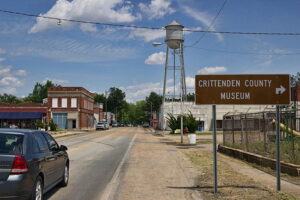
Listening to Black Communities
The Environmental Defense Fund, which arranged the Arkansas meetup, planned another “climate and community roundtable” for Black mayors in Mississippi in October at the Mississippi Civil Rights Museum in Jackson. Those elected leaders and their constituents face the same needs – and a shared conundrum: What might under-resourced, dying Delta towns and other municipalities demand in exchange for allowing polluting, water- and energy-guzzling data centers inside their borders?
“If you look at a map, most of them are coming to rural, small communities where Black people are, where there’s massive available land and where people often aren’t that savvy about what the outcomes of these centers are,” said Arkansas-born Stacie Walters Fujii, a lawyer and political consultant based in Washington, D.C., and Atlanta.
As the Environmental Defense Fund’s fellow to the African American Mayors Association, Fujii helps members of the association, which launched a mayoral climate action training program in 2025, expand their capacity to mitigate the effects of climate change on their communities.
Data center developers “come under the auspices of offering jobs, right, or even investment,” Fujii said. ”What we’ve found is that some of the mayors understand community benefit agreements, where you ask for what you want. And some of them don’t even know what to ask for.”
The federal government does not maintain a data center registry; privately run Data Center Map has counted more than 4,700 centers across the United States. Of the 1,500 data centers being planned nationwide, 67% have been slated for rural areas mainly in the South and Midwest. That’s according to an April 2026 Pew Research Center analysis.
Recent pauses on data centers by Democrat and Republican lawmakers alike, at least partly, reflect election-year politics. Still, Fujii and others say it seems more a matter of where and when — not whether — more centers will be green lit.
Prompted by those prospects and a whole spate of environmental issues and concerns in the Delta, the Environmental Defense Fund’s Asia Guest initiated the roundtables of Arkansas and Mississippi mayors. Stunned by its inequities and struck by its beauty, Georgia-born Guest stayed in her adopted state after graduating from the University of Mississippi. She lives in Oxford, 80 miles southeast of Memphis.
After attending the Congressional Black Caucus’ 2025 yearly meeting in Tunica, Mississippi, Guest, the environmental organization’s community engagement and collaboration programs coordinator, got in her car and started driving.
During her self-styled listening tour, she got earfuls about what was lacking. Some municipalities had no full-time fire department. In at least one town, the police chief doubled as his agency’s only patrol officer. Several towns couldn’t afford to provide health insurance to government workers. Town after town lacked a recent, usable analysis of the risks of living smack within a giant flood plain.
“They were, like, ‘We have all these other issues,’” Guest said. “So, when I started, data centers weren’t a major, key issue. Now, for a few of them, it is.”
Will Data Centers Pay Off?
What’s known in geological terms as the Mississippi River alluvial plain engulfs almost a third of Arkansas, a fourth of Tennessee, a 10th of Mississippi and swaths stretching from southern Illinois and western Kentucky down through Louisiana and into the Gulf of Mexico. In the southern reaches commonly called the Delta, a fertile, flood-prone, historically agricultural region, some of the nation’s poorest people have long languished.
Earle is 28 miles west of Memphis. During the Arkansas mayors’ meetup, Memphis Mayor Paul Young laid out how and why he joined a majority of the City Council in allowing a cluster of Elon Musk’s SpaceX data centers to open in his majority-Black city since 2024.
Backed by the Memphis Chamber of Commerce and protested by an array of local people, that initial Musk facility opened in a South Memphis neighborhood, Boxwood, that freedmen founded in 1863. More than 90% of South Memphis residents are Black, according to a University of California at Berkeley Othering & Belonging Institute study. The same percentage of Black people live in Memphis’ Whitehaven neighborhood, the site of a second major SpaceX facility that crosses state lines into Southaven, Mississippi. Anthropic and Google are center tenants. The 785,000 square foot southwest Memphis facility is reportedly directly recruiting for 140 jobs (roughly one third are for engineers), leaving many local business leaders skeptical about the value of the employment opportunities data centers may bring to the region.
Further on, in mid-August 2026, city leaders issued a moratorium, feeling blind-sided, some said, after Musk announced his determination to build a third data center in Memphis.
Seventy-five miles deeper into the Delta, in Clarksdale, Mississippi, the board of commissioners voted in March 2026 to designate 648 acres for a hyperscale data center. The mayor and commissioners of that city in the heart of the Delta wouldn’t specify the name of the company they were negotiating with, saying only that it was global and would pay $5 million upfront.
More than 80% of Clarksdale’s 14,000 residents are Black. More than half of them live below the federal poverty line. Elected officials and leaders of the Crossroads Economic Partnership for Clarksdale and neighboring Coahoma have projected that the center would generate 1,000 temporary jobs and 200 permanent ones.
But there hasn’t been enough transparency about the prospective data center, some Clarksdale residents have argued. What will be the health and environmental effects of a data center? Are the promised jobs worth the trade-off?
They also question if local people will have the skills required for those temporary jobs and, certainly, for the full-time ones. A Brookings Institute analysis, updated in August 2026, suggests that center owners and planners do inflate their job estimates.
“These centers don’t bring as many jobs as they say,” the Environmental Defense Fund’s Guest said. “And a lot of these towns have way more than a few people who need a good job.”
Officially, the Environmental Defense Fund isn’t for or against data centers. It does warn of the environmental fallout and wants elected officials and their constituents to have proof of all the potential costs, risks and benefits.
It wants communities to be able to connect the dots between, not just the pressing issue of data centers, but also other everyday things intersecting and affecting the environment. For example, a shipping container will soon house a grocery store for residents of Walls, Mississippi, to help them avoid the 10-mile trip to the nearest full-service grocer, a Walmart in Southaven.
“The environment is in everything we do,” Guest said. “If it’s super-hot and you’ve got to wait on the school bus and you haven’t had breakfast because no one could make that drive, how will that affect what you learn?
“If you’re an older person with a chronic illness and you’ve no access to fruits and vegetables — except for what might be at the Dollar General — you end up traveling to the emergency room by ambulance.” That requires cash and ratchets up a body’s stress. Depending on the mode of transportation, it pollutes the air.
Those, too, are among the many realities the Environmental Defense Fund hopes will become top of mind for elected leaders and community people. The meetups to explore what communities possess, what they lack and how they should move regarding, say, data centers are designed to create brain trusts of Black mayors and the people they vow to serve and who, in large measure, should be steering the conversation.
“The beauty of this,” said Tonya Calhoun, the defense fund’s Atlanta-based senior director of community engagement, “is that these smaller communities will find ways to share what they’re learning as they come together and collaborate.
“The aim is that these smaller cities can see the hope and the possibility.”
Katti Gray is an award-winning journalist specializing in health and criminal justice. She resides in New York and Little Rock, Arkansas, her hometown.